Rating Review - Rebalancing our Rating System
Consultation has concluded
Council is reviewing the basis of its rating structure and has developed a proposal that rebalances the distribution of rates.
The community is invited to learn how Council's rating system works today, understand the factors that influence rating decisions and share views on the proposal. Feedback will help Council identify what’s working and consider whether adjustments are needed to meet community expectations and better support equity and long-term financial sustainability.
The focus of the Rating Review is on how rates are distributed, not how much revenue Council raises or what services are delivered.
The review considers:
Rating distribution and trends in property value across the District;
Land use and ownership patterns;
Capacity to pay across different property types; and
The District’s socio-economic diversity, business diversity and community values.
To learn more, read A Review of the Basis of Rating Consultation Paper - Part A online here - you'll find it in the Resource Library - or in-person at Council's Main Office or the Yankalilla Library.
Why a review is being undertaken
The last comprehensive review of Council’s rating structure was completed in 2016. Since then, the District has experienced significant change, including:
Growth in property valuations;
Shifts in land use, with more mixed-use and non-primary production ownership of rural land;
Evolving community needs and expectations; and
Perceptions of inequity, especially between town and rural properties.
This review provides an opportunity to:
Distribute rates equitably across property types;
Align rating practices with community values and capacity to pay;
Consider adjustments that enhance sustainability and fairness; and
Strengthen transparency and understanding of how rating decisions are made.
Phased engagement program
Phase 1 ran across December late last year. It was all about starting the conversation, raising awareness about the project and helping everyone understand how the rating system works and how rates are calculated.
We're now in Phase 2 and there's several opportunities for you to inform Council’s decision-making. We’re focused on opening up discussion, sharing perspectives and making sure everyone has the chance to explore the proposal.
Here's how you can participate in Phase 2:
- Once released (later this week) read Part B of A Review of the Basis of Rating – Consultation Paper
- Come along to the Community Workshop at the Myponga Hall, MON, 19 January 3pm - 6:30pm
- Provide feedback at the Pop-Up Engagement Stand, Australia Day celebrations at Memorial Park, Yankalilla, MON 26 January 8am - 11am.
- Provide a verbal submission at the Public Meeting, held in conjunction with the Council Meeting, TUES, 17 February 6pm - 7pm
- Provide a written submission by email to participate@yankalilla.sa.gov.au or post to PO Box 9, Yankalilla SA 5203
- Complete the Survey Form online here or pick up a hard copy from Council
To learn more:
- Register to follow the project - We'll keep the conversation going with regular updates.
- Ask a question or leave a comment here on Your Say Yankalilla
- Email us participate@yankalilla.sa.gov.au
- Prefer a conversation? Contact Council staff on (08) 8558 0200 to arrange a time to discuss.
Council is reviewing the basis of its rating structure and has developed a proposal that rebalances the distribution of rates.
The community is invited to learn how Council's rating system works today, understand the factors that influence rating decisions and share views on the proposal. Feedback will help Council identify what’s working and consider whether adjustments are needed to meet community expectations and better support equity and long-term financial sustainability.
The focus of the Rating Review is on how rates are distributed, not how much revenue Council raises or what services are delivered.
The review considers:
Rating distribution and trends in property value across the District;
Land use and ownership patterns;
Capacity to pay across different property types; and
The District’s socio-economic diversity, business diversity and community values.
To learn more, read A Review of the Basis of Rating Consultation Paper - Part A online here - you'll find it in the Resource Library - or in-person at Council's Main Office or the Yankalilla Library.
Why a review is being undertaken
The last comprehensive review of Council’s rating structure was completed in 2016. Since then, the District has experienced significant change, including:
Growth in property valuations;
Shifts in land use, with more mixed-use and non-primary production ownership of rural land;
Evolving community needs and expectations; and
Perceptions of inequity, especially between town and rural properties.
This review provides an opportunity to:
Distribute rates equitably across property types;
Align rating practices with community values and capacity to pay;
Consider adjustments that enhance sustainability and fairness; and
Strengthen transparency and understanding of how rating decisions are made.
Phased engagement program
Phase 1 ran across December late last year. It was all about starting the conversation, raising awareness about the project and helping everyone understand how the rating system works and how rates are calculated.
We're now in Phase 2 and there's several opportunities for you to inform Council’s decision-making. We’re focused on opening up discussion, sharing perspectives and making sure everyone has the chance to explore the proposal.
Here's how you can participate in Phase 2:
- Once released (later this week) read Part B of A Review of the Basis of Rating – Consultation Paper
- Come along to the Community Workshop at the Myponga Hall, MON, 19 January 3pm - 6:30pm
- Provide feedback at the Pop-Up Engagement Stand, Australia Day celebrations at Memorial Park, Yankalilla, MON 26 January 8am - 11am.
- Provide a verbal submission at the Public Meeting, held in conjunction with the Council Meeting, TUES, 17 February 6pm - 7pm
- Provide a written submission by email to participate@yankalilla.sa.gov.au or post to PO Box 9, Yankalilla SA 5203
- Complete the Survey Form online here or pick up a hard copy from Council
To learn more:
- Register to follow the project - We'll keep the conversation going with regular updates.
- Ask a question or leave a comment here on Your Say Yankalilla
- Email us participate@yankalilla.sa.gov.au
- Prefer a conversation? Contact Council staff on (08) 8558 0200 to arrange a time to discuss.
Ask your questions here and we'll post the response so that everyone can read it.
-
Share I have read the January / February edition of Yankalilla Regional News with particular interest in the conversation in relation to the rates review. I am seeking council’s definition of Vacant Land as their appears to be a difference of definition in two articles in YRN I note that in the article by Clr Gibbs and Clr Hatch that Clr Gibbs makes comment that (paraphrasing) in the section Changing the Differential Rating, “increasing the Vacant Land RID…..is trying to prevent land banking and to encourage owners to build quicker”. As the term suggests Vacant Land is that which is vacant with no dwellings on them. However in article Rates Review for Yankalilla Council (pg 13), Fiona Vogel states that, under the heading Increasing the differential rate for vacant land, that this deals primarily “pings people with holiday homes”. These are not Vacant Land. These have dwellings upon them. Arguing that these owners are not “present to offer their energy and ideas to the area, bring economic growth, or just be a customer at the local shops year round” is not an argument to increase the rates for ‘Vacant Land’. It could be equally argued that these owners use the roads less, use waste services less. For example, despite paying a not dissimilar to those properties that have sealed roads leading to their properties we still do not have one. Should we pay less rates? Could the definition of Vacant Land be clarified please. on Facebook Share I have read the January / February edition of Yankalilla Regional News with particular interest in the conversation in relation to the rates review. I am seeking council’s definition of Vacant Land as their appears to be a difference of definition in two articles in YRN I note that in the article by Clr Gibbs and Clr Hatch that Clr Gibbs makes comment that (paraphrasing) in the section Changing the Differential Rating, “increasing the Vacant Land RID…..is trying to prevent land banking and to encourage owners to build quicker”. As the term suggests Vacant Land is that which is vacant with no dwellings on them. However in article Rates Review for Yankalilla Council (pg 13), Fiona Vogel states that, under the heading Increasing the differential rate for vacant land, that this deals primarily “pings people with holiday homes”. These are not Vacant Land. These have dwellings upon them. Arguing that these owners are not “present to offer their energy and ideas to the area, bring economic growth, or just be a customer at the local shops year round” is not an argument to increase the rates for ‘Vacant Land’. It could be equally argued that these owners use the roads less, use waste services less. For example, despite paying a not dissimilar to those properties that have sealed roads leading to their properties we still do not have one. Should we pay less rates? Could the definition of Vacant Land be clarified please. on X (formerly Twitter) Share I have read the January / February edition of Yankalilla Regional News with particular interest in the conversation in relation to the rates review. I am seeking council’s definition of Vacant Land as their appears to be a difference of definition in two articles in YRN I note that in the article by Clr Gibbs and Clr Hatch that Clr Gibbs makes comment that (paraphrasing) in the section Changing the Differential Rating, “increasing the Vacant Land RID…..is trying to prevent land banking and to encourage owners to build quicker”. As the term suggests Vacant Land is that which is vacant with no dwellings on them. However in article Rates Review for Yankalilla Council (pg 13), Fiona Vogel states that, under the heading Increasing the differential rate for vacant land, that this deals primarily “pings people with holiday homes”. These are not Vacant Land. These have dwellings upon them. Arguing that these owners are not “present to offer their energy and ideas to the area, bring economic growth, or just be a customer at the local shops year round” is not an argument to increase the rates for ‘Vacant Land’. It could be equally argued that these owners use the roads less, use waste services less. For example, despite paying a not dissimilar to those properties that have sealed roads leading to their properties we still do not have one. Should we pay less rates? Could the definition of Vacant Land be clarified please. on Linkedin Email I have read the January / February edition of Yankalilla Regional News with particular interest in the conversation in relation to the rates review. I am seeking council’s definition of Vacant Land as their appears to be a difference of definition in two articles in YRN I note that in the article by Clr Gibbs and Clr Hatch that Clr Gibbs makes comment that (paraphrasing) in the section Changing the Differential Rating, “increasing the Vacant Land RID…..is trying to prevent land banking and to encourage owners to build quicker”. As the term suggests Vacant Land is that which is vacant with no dwellings on them. However in article Rates Review for Yankalilla Council (pg 13), Fiona Vogel states that, under the heading Increasing the differential rate for vacant land, that this deals primarily “pings people with holiday homes”. These are not Vacant Land. These have dwellings upon them. Arguing that these owners are not “present to offer their energy and ideas to the area, bring economic growth, or just be a customer at the local shops year round” is not an argument to increase the rates for ‘Vacant Land’. It could be equally argued that these owners use the roads less, use waste services less. For example, despite paying a not dissimilar to those properties that have sealed roads leading to their properties we still do not have one. Should we pay less rates? Could the definition of Vacant Land be clarified please. link
I have read the January / February edition of Yankalilla Regional News with particular interest in the conversation in relation to the rates review. I am seeking council’s definition of Vacant Land as their appears to be a difference of definition in two articles in YRN I note that in the article by Clr Gibbs and Clr Hatch that Clr Gibbs makes comment that (paraphrasing) in the section Changing the Differential Rating, “increasing the Vacant Land RID…..is trying to prevent land banking and to encourage owners to build quicker”. As the term suggests Vacant Land is that which is vacant with no dwellings on them. However in article Rates Review for Yankalilla Council (pg 13), Fiona Vogel states that, under the heading Increasing the differential rate for vacant land, that this deals primarily “pings people with holiday homes”. These are not Vacant Land. These have dwellings upon them. Arguing that these owners are not “present to offer their energy and ideas to the area, bring economic growth, or just be a customer at the local shops year round” is not an argument to increase the rates for ‘Vacant Land’. It could be equally argued that these owners use the roads less, use waste services less. For example, despite paying a not dissimilar to those properties that have sealed roads leading to their properties we still do not have one. Should we pay less rates? Could the definition of Vacant Land be clarified please.
KymG asked 9 months agoThanks for asking for clarification - we appreciate the opportunity to clear up any mixed messaging. Here's the extracts directly from the Rating Review Report:
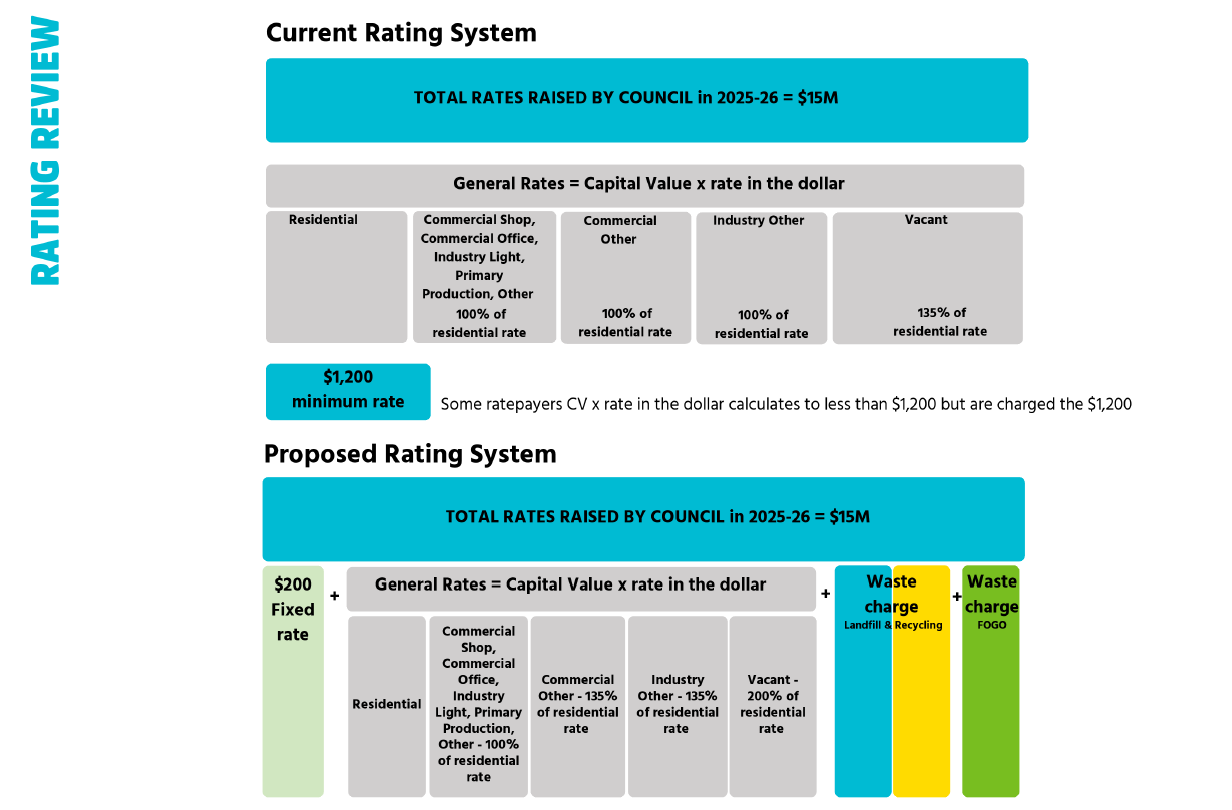
Council is proposing to increase the Differential for Vacant Land from 135% to 200% compared to the Rate in the Dollar (RID) for Residential properties.
Reasons for Increasing the Differential for Vacant Land
There is concern within the community about the availability of housing, including long-term rental housing. This is a concern in many councils. One strategy is to increase Vacant Land rates to discourage Land Banking and encourage owners to either build on their properties or sell them to others for development. Council’s infrastructure still has to be built and maintained regardless of whether properties have housing or are vacant.
Council is proposing to increase the Differential for Commercial Other properties from 100% to 135% compared to the RID for Residential properties.
Reasons for Increasing the Differential for Commercial Other and Industry Other properties.
Larger businesses are rated as Commercial Other and Industry Other. Ratepayers owning these types of properties potentially have a higher capacity to pay rates than typical local Residential property ratepayers.
Many councils are exploring ways to apply higher rates to short-term rental properties listed on platforms such as Airbnb and Stayz. The aim is to incentivise property owners to offer long-term rentals, helping alleviate housing shortages.
In South Australia, councils are awaiting further guidance from the State Government following the SA Parliament Select Committee inquiry into short-stay accommodation. Currently, most short-term rental properties are classified as Residential, meaning they pay the same rate in the dollar as long-term residential properties.
A proposed approach would reclassify short-term rentals under the land use category Commercial Other rather than Residential. This change would allow councils to apply a higher differential rate to these properties. At present, the differential for Commercial Other and Industry Other properties is set at 100%, the same as Residential. The council is proposing to increase this differential to 135%, enabling higher rates for short-term rentals in the future.
-
Share Q1. Why is there such inequality in the residential rate change between low and high value properties (overall a 2% tax increase) - from posted table 5 example.... 1. House in Cape Jervis valued at $330,000 = 32% increase. 2. House in Carrickalinga valued at $3,550,000 = 13% DECREASE. Q2. What is the formula for calculating this? on Facebook Share Q1. Why is there such inequality in the residential rate change between low and high value properties (overall a 2% tax increase) - from posted table 5 example.... 1. House in Cape Jervis valued at $330,000 = 32% increase. 2. House in Carrickalinga valued at $3,550,000 = 13% DECREASE. Q2. What is the formula for calculating this? on X (formerly Twitter) Share Q1. Why is there such inequality in the residential rate change between low and high value properties (overall a 2% tax increase) - from posted table 5 example.... 1. House in Cape Jervis valued at $330,000 = 32% increase. 2. House in Carrickalinga valued at $3,550,000 = 13% DECREASE. Q2. What is the formula for calculating this? on Linkedin Email Q1. Why is there such inequality in the residential rate change between low and high value properties (overall a 2% tax increase) - from posted table 5 example.... 1. House in Cape Jervis valued at $330,000 = 32% increase. 2. House in Carrickalinga valued at $3,550,000 = 13% DECREASE. Q2. What is the formula for calculating this? link
Q1. Why is there such inequality in the residential rate change between low and high value properties (overall a 2% tax increase) - from posted table 5 example.... 1. House in Cape Jervis valued at $330,000 = 32% increase. 2. House in Carrickalinga valued at $3,550,000 = 13% DECREASE. Q2. What is the formula for calculating this?
BT asked 9 months agoThank you for raising this - it’s a good question that highlights some of the differences that can occur with the proposed approach. Examples like these are intended to support discussion about potential impacts and the trade-offs involved. Here's the detail from the Finance Team:
1. Why is there such inequality? (32% Increase vs. 13% Decrease)
The difference in percentage change arises because the Council is proposing to switch the rating structure from a Minimum Rate system to a Fixed Charge system, combined with a separate Waste Charge.
Why High-Value Properties (e.g., $3.55M in Carrickalinga) Pay Less: The proposed change removes waste costs from the General Rates and utilises a Fixed Charge, both of which significantly lower the Rate in the Dollar (RID),.
• Effect: High-value properties pay the vast majority of their rates based on the variable Rate in the Dollar. When the Rate in the Dollar decreases, their total payable amount drops significantly. This reduction in the variable rate is large enough to offset the addition of the separate Fixed and Waste charges.
Why Low-Value Properties (e.g., $330k in Cape Jervis) Pay More: Low-value properties are impacted by the removal of the Minimum Rate "floor" and the introduction of multiple separate charges.
• Current Situation: Under the current system, if a property’s calculated rate is low, it is raised to the Minimum Rate of $1,200,. Waste costs are currently included within this single payment.
• Proposed Situation: Under the new system, these properties must pay the Fixed Charge ($200) plus the new Waste Charge, plus their property value multiplied by the RID.
• The Result: Even though the RID is lower, the sum of the separate Fixed Charge, Waste Charge, and the variable rate often totals more than the previous $1,200 minimum. The consultation paper explicitly notes that "A Fixed Charge generally has a lower rate in the dollar, so high-valued properties pay less... and lower-valued properties pay more".
2. What is the formula for calculating this?
The formulas below illustrate how the total bill is constructed under the two different systems.
Formula A: Current System (Minimum Rate)
Currently, the Council calculates rates based on property value. If the result is below the set threshold, the Minimum Rate applies. Waste management costs are currently bundled into this calculation.
Rates = Property Value × Current RID
• Condition: If the result is less than $1,200, then the ratepayer pays the minimum charge of $1,200.
• Condition: If the result is more than $1,200, the ratepayer pays the calculated amount using the formula Rates=Property Value×Current RID
Formula B: Proposed System (Fixed Charge + Waste Charge)
Under the proposal, all ratepayers pay two specific charges first, then add the value-based calculation on top. The "New RID" is lower because the separate charges have already collected a portion of the required revenue.
Total Bill=Fixed Charge ($200) + Waste Charge + (Property Value × New Lower RID)
• Fixed Charge: $200 applied to every rateable property.
• Waste Charge: A separate fee to cover collection and treatment costs (applied to properties receiving the service).
• Variable Rate: The property value multiplied by the new, lower RID
-
Share Just noticed in the scenario modelling for a $700k Residential property, under the proposed system, the Capital Value is multiplied by a different - lower- rate in the dollar than the present. Why is that? Is the rate in the dollar to change because of the introduction of a the fixed charge. Sorry if this is explained elsewhere and I have missed it. on Facebook Share Just noticed in the scenario modelling for a $700k Residential property, under the proposed system, the Capital Value is multiplied by a different - lower- rate in the dollar than the present. Why is that? Is the rate in the dollar to change because of the introduction of a the fixed charge. Sorry if this is explained elsewhere and I have missed it. on X (formerly Twitter) Share Just noticed in the scenario modelling for a $700k Residential property, under the proposed system, the Capital Value is multiplied by a different - lower- rate in the dollar than the present. Why is that? Is the rate in the dollar to change because of the introduction of a the fixed charge. Sorry if this is explained elsewhere and I have missed it. on Linkedin Email Just noticed in the scenario modelling for a $700k Residential property, under the proposed system, the Capital Value is multiplied by a different - lower- rate in the dollar than the present. Why is that? Is the rate in the dollar to change because of the introduction of a the fixed charge. Sorry if this is explained elsewhere and I have missed it. link
Just noticed in the scenario modelling for a $700k Residential property, under the proposed system, the Capital Value is multiplied by a different - lower- rate in the dollar than the present. Why is that? Is the rate in the dollar to change because of the introduction of a the fixed charge. Sorry if this is explained elsewhere and I have missed it.
Lmfelix asked 9 months agoIt’s a reasonable thing to query - thanks for picking it up. We passed this question to the Finance Team so we can provide a clear and accurate explanation of how the proposed model works - here's what they had to say:
You are correct in your observation, and thank you for asking for some clarity. Under the proposed model, the Rate in the Dollar (RID) applied to a Capital Value is significantly lower than the current rate.
You asked if this is because of the Fixed Charge - the answer is yes, but there is also a second major reason for the reduction.
Here is why the Rate in the Dollar drops under the proposed system:
1. Introduction of the Waste Charge: The proposal involves removing the cost of waste collection and treatment from the General Rates budget and charging it separately as a "Waste Charge". Because this $1.2 million is no longer being collected through the variable rate based on your property value, the Rate in the Dollar for General Rates is lowered significantly.
2. Switching to a Fixed Charge: You are right that the Fixed Charge plays a role. Under a Fixed Charge system, the Council collects a set amount (proposed at $200) from every ratepayer first. The remaining revenue required is then divided by property values to determine the Rate in the Dollar. This method generally produces a lower Rate in the Dollar compared to a Minimum Rate system (our current system), where the rate must be higher to ensure enough revenue is collected before the minimum floor kicks in.
In Summary: By moving $1.2 million into a separate Waste Charge and collecting a flat $200 Fixed Charge from everyone, the "variable" portion of the rates bill (the part based on your property value) decreases.
In the modelling you viewed, these changes cause the Residential Rate in the Dollar to drop from the current 0.00367981 to a proposed 0.003011021. This is why your Capital Value is being multiplied by a lower figure in the proposed scenario.
-
Share Thank you for the scenario modelling. Is it fair to say that this is a "yes" or "no" consultation? Either we keep the present system or we change to the proposed system. There is no Version 2. on Facebook Share Thank you for the scenario modelling. Is it fair to say that this is a "yes" or "no" consultation? Either we keep the present system or we change to the proposed system. There is no Version 2. on X (formerly Twitter) Share Thank you for the scenario modelling. Is it fair to say that this is a "yes" or "no" consultation? Either we keep the present system or we change to the proposed system. There is no Version 2. on Linkedin Email Thank you for the scenario modelling. Is it fair to say that this is a "yes" or "no" consultation? Either we keep the present system or we change to the proposed system. There is no Version 2. link
Thank you for the scenario modelling. Is it fair to say that this is a "yes" or "no" consultation? Either we keep the present system or we change to the proposed system. There is no Version 2.
Lmfelix asked 9 months agoThank you for the question. This isn’t a simple “yes or no” consultation. The purpose of sharing the scenario modelling, the Consultation Papers and the opportunities to for discussion is to help the community understand the proposed approach, explore its potential impacts and discuss the trade-offs involved.
Your feedback will help Council understand what’s working, what concerns people have and whether elements of the proposal should be refined before any decisions are made. In that sense, the consultation is about shaping the way forward - not just choosing between two fixed options.
-
Share Are you going to discuss waste management in the Yankalilla area for rural/non rural properties in regards to all residents having access to green bin service? Rural properties do not get a green bin service/green bin. Currently I am assuming that all residents pay the same for waste management in the area but rural residents are missing out on 'green bin' service. As a rural resident I am only able to burn part of the year. Seems unfair can't get green waste collected. on Facebook Share Are you going to discuss waste management in the Yankalilla area for rural/non rural properties in regards to all residents having access to green bin service? Rural properties do not get a green bin service/green bin. Currently I am assuming that all residents pay the same for waste management in the area but rural residents are missing out on 'green bin' service. As a rural resident I am only able to burn part of the year. Seems unfair can't get green waste collected. on X (formerly Twitter) Share Are you going to discuss waste management in the Yankalilla area for rural/non rural properties in regards to all residents having access to green bin service? Rural properties do not get a green bin service/green bin. Currently I am assuming that all residents pay the same for waste management in the area but rural residents are missing out on 'green bin' service. As a rural resident I am only able to burn part of the year. Seems unfair can't get green waste collected. on Linkedin Email Are you going to discuss waste management in the Yankalilla area for rural/non rural properties in regards to all residents having access to green bin service? Rural properties do not get a green bin service/green bin. Currently I am assuming that all residents pay the same for waste management in the area but rural residents are missing out on 'green bin' service. As a rural resident I am only able to burn part of the year. Seems unfair can't get green waste collected. link
Are you going to discuss waste management in the Yankalilla area for rural/non rural properties in regards to all residents having access to green bin service? Rural properties do not get a green bin service/green bin. Currently I am assuming that all residents pay the same for waste management in the area but rural residents are missing out on 'green bin' service. As a rural resident I am only able to burn part of the year. Seems unfair can't get green waste collected.
rural dweller asked 11 months agoThanks for your question about waste services for rural properties. At the moment, kerbside green-waste bins are only available in township areas and rural properties do not receive a green bin service. We understand this can feel inequitable, especially if it appears everyone is paying the same but receiving different services.
As part of the Rating Review, Council is considering a separate Waste Charge. The Waste Charge is designed to clearly show the real cost of collecting and treating waste. Currently, these costs (around $1.2 million per year) are included within general rates. Moving this cost out of general rates and making it a separate charge would:
- increase transparency
- reduce the “Rate in the Dollar” for general rates
- show clearly who pays for waste and who receives a waste service
Under the legislation, a Waste Charge can apply to both rateable and non-rateable land. That means non-rateable properties – which don’t currently contribute to waste costs – would start contributing if they receive a waste service. The Waste Charge would not apply to vacant land unless a waste service is provided.For rural properties, distance from a collection point (property entrance or bin bank) makes a difference. Legislation provides that:
- within 500m – charged in full
- 500m and <2km – charged at 75%
- 2km and <5km – charged at 50%
- 5km from collection point – no charge
Introducing a Waste Charge does not automatically expand green-bin services to rural areas, but it does highlight service differences and helps Council understand whether current arrangements remain fair. Your feedback brings feedback about green-waste access to the conversation, thank you.
-
Share Exactly what are you proposing .. You paper is gobbledygook to me .. So a house valued at $400K or a farm values at $2 million with a land area of 20 hectors. What would the old rate be and the new proposed rate with all the value added costs such as waste removal etc added. Exactly how much change in percentage rate will we be looking at. Note valuations have increased as property values increased so rates have increased, however the current economic collapse as reported in China and other countries may effect us dramatically in a very short period. So the second question is do you have a plan for a massive loss of revenue. Which might very well happen over the next 5 years. A third question is ... What is your current debt in terms on borrowings and what percentage of current council rates do they cost to service. I was informed that the Onkaparinga Council had a debt in access of 250 million from various projects that have been described by one councilor as non essential. This was from private conversation, pre 2020. No planning to recoup or cover those borrowings existed at the time of conversation. I know that Marion council is funding a fact finding trip to Rio, not for carnavil as some suggest. on Facebook Share Exactly what are you proposing .. You paper is gobbledygook to me .. So a house valued at $400K or a farm values at $2 million with a land area of 20 hectors. What would the old rate be and the new proposed rate with all the value added costs such as waste removal etc added. Exactly how much change in percentage rate will we be looking at. Note valuations have increased as property values increased so rates have increased, however the current economic collapse as reported in China and other countries may effect us dramatically in a very short period. So the second question is do you have a plan for a massive loss of revenue. Which might very well happen over the next 5 years. A third question is ... What is your current debt in terms on borrowings and what percentage of current council rates do they cost to service. I was informed that the Onkaparinga Council had a debt in access of 250 million from various projects that have been described by one councilor as non essential. This was from private conversation, pre 2020. No planning to recoup or cover those borrowings existed at the time of conversation. I know that Marion council is funding a fact finding trip to Rio, not for carnavil as some suggest. on X (formerly Twitter) Share Exactly what are you proposing .. You paper is gobbledygook to me .. So a house valued at $400K or a farm values at $2 million with a land area of 20 hectors. What would the old rate be and the new proposed rate with all the value added costs such as waste removal etc added. Exactly how much change in percentage rate will we be looking at. Note valuations have increased as property values increased so rates have increased, however the current economic collapse as reported in China and other countries may effect us dramatically in a very short period. So the second question is do you have a plan for a massive loss of revenue. Which might very well happen over the next 5 years. A third question is ... What is your current debt in terms on borrowings and what percentage of current council rates do they cost to service. I was informed that the Onkaparinga Council had a debt in access of 250 million from various projects that have been described by one councilor as non essential. This was from private conversation, pre 2020. No planning to recoup or cover those borrowings existed at the time of conversation. I know that Marion council is funding a fact finding trip to Rio, not for carnavil as some suggest. on Linkedin Email Exactly what are you proposing .. You paper is gobbledygook to me .. So a house valued at $400K or a farm values at $2 million with a land area of 20 hectors. What would the old rate be and the new proposed rate with all the value added costs such as waste removal etc added. Exactly how much change in percentage rate will we be looking at. Note valuations have increased as property values increased so rates have increased, however the current economic collapse as reported in China and other countries may effect us dramatically in a very short period. So the second question is do you have a plan for a massive loss of revenue. Which might very well happen over the next 5 years. A third question is ... What is your current debt in terms on borrowings and what percentage of current council rates do they cost to service. I was informed that the Onkaparinga Council had a debt in access of 250 million from various projects that have been described by one councilor as non essential. This was from private conversation, pre 2020. No planning to recoup or cover those borrowings existed at the time of conversation. I know that Marion council is funding a fact finding trip to Rio, not for carnavil as some suggest. link
Exactly what are you proposing .. You paper is gobbledygook to me .. So a house valued at $400K or a farm values at $2 million with a land area of 20 hectors. What would the old rate be and the new proposed rate with all the value added costs such as waste removal etc added. Exactly how much change in percentage rate will we be looking at. Note valuations have increased as property values increased so rates have increased, however the current economic collapse as reported in China and other countries may effect us dramatically in a very short period. So the second question is do you have a plan for a massive loss of revenue. Which might very well happen over the next 5 years. A third question is ... What is your current debt in terms on borrowings and what percentage of current council rates do they cost to service. I was informed that the Onkaparinga Council had a debt in access of 250 million from various projects that have been described by one councilor as non essential. This was from private conversation, pre 2020. No planning to recoup or cover those borrowings existed at the time of conversation. I know that Marion council is funding a fact finding trip to Rio, not for carnavil as some suggest.
healionr asked 11 months agoWe know the consultation paper includes a lot of information, so here’s a summarised explanation of what is happening and what you can expect.
1. What exactly is being proposed?
Right now, Council is not proposing to increase the total amount of rates collected. The amount of rates required is a separate process that happens each year when Council considers its Long-Term Financial Plan, develops its Annual Business Plan & Budget and consults with the community.
On this occasion, Council is reviewing how the current rates are shared across different types of properties to make sure the system is fair.
Phase 1 of this community engagement program explains the structure of rating being considered – things like a fixed charge, adjusting differentials for certain land uses and introducing a Waste Charge.
Phase 1 is the first step. The detailed, property-by-property examples you’re asking for – such as what a $400K home or a $2M farm would pay – will be included in Phase 2 of the community engagement program.
Phase 2 will explain:
- the current rate for different property types
- the proposed rate under the new structure
- how this changes in dollars and in percentage terms
- the effect of the Fixed Charge
- the effect of the Waste Charge
You will be able to see how the proposal affects several example properties in each rating category (Residential, Primary Production, Vacant Land, Commercial etc).Rate revenue is set by Council each year as the last step in preparing the budget.
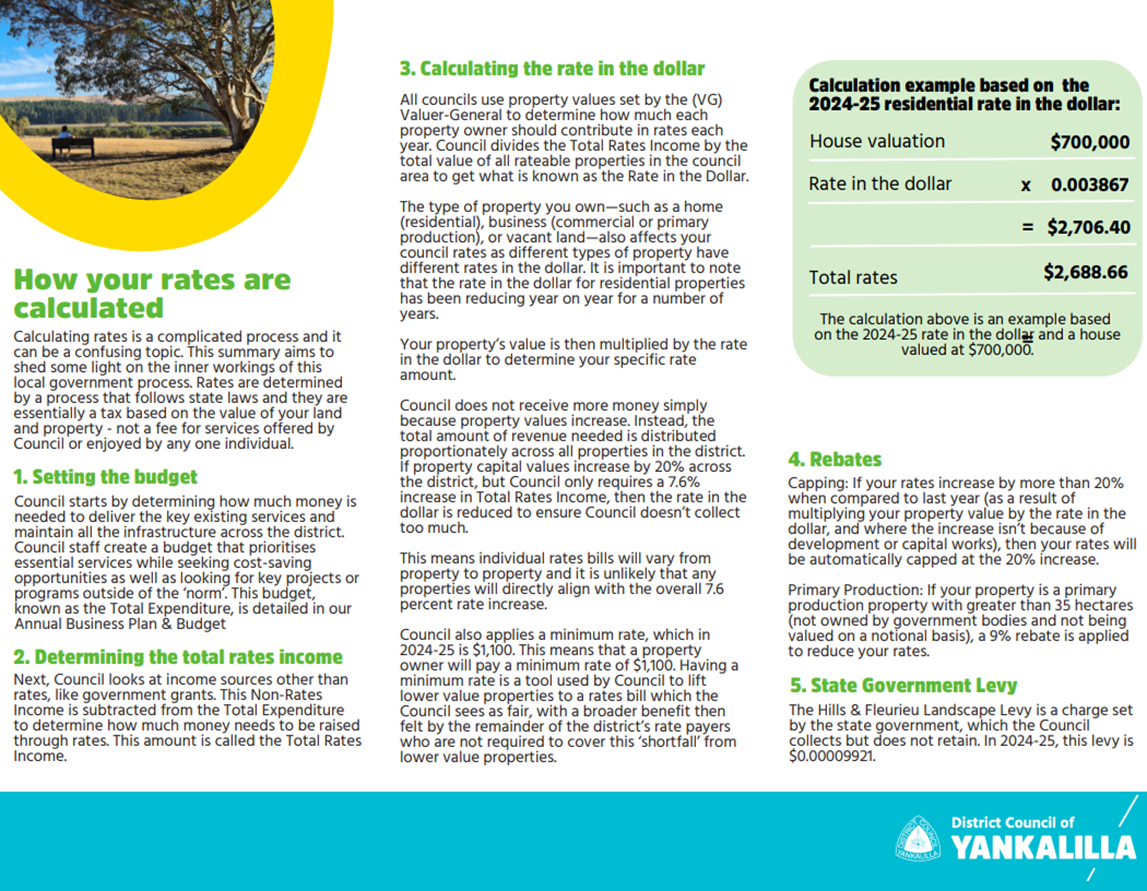
The ‘rate in the dollar’ is calculated by taking the total Rates Revenue Council identifies as necessary to raise and dividing it by the total Capital Value of the properties in our district.If property values go up, Council does not automatically receive more money.
Property values are determined by the Valuer General.
- If the total property values for the district rise, the rate in the dollar falls.
- If values fall, the rate in the dollar rises.
This is how all councils in South Australia operate under the Local Government Act 1999.
2. What if the economy gets worse?
Council plans ahead for economic changes. We do this through our 10-year Long-Term Financial Plan, which includes:
- economic scenario planning
- managing revenue risks
- careful borrowing
- maintaining essential services
- controlling costs
- building financial resilience over time
3. What is Council’s debt situation?As at the end of October 2025, Council reported a total debt figure of $13.8M. The full details of the loan balances are published every month in the monthly Finance Report as well as annually in the Annual Report through the audited Financial Statements.
In the recently revised 2025-26 budget (Budget Review 1), finance costs (interest on loans) was forecast at $662K. This equates to 4.18% of Total Rates Revenue, or 3.4% of Total Revenue (as Council receives income from other sources than just rates).
-
Share Considering the change from a minimum rate to a fixed charge, the first reason listed is, effectively, because two thirds of country SA councils do it. The second reason listed is that Primary Production properties have higher rates than neighbouring councils, yet neighbouring councils have lower Differential RID for Primary Production properties. Why opt for Fixed Charge to help reduce rates for higher valued properties in this category rather than a lower Differential RID? on Facebook Share Considering the change from a minimum rate to a fixed charge, the first reason listed is, effectively, because two thirds of country SA councils do it. The second reason listed is that Primary Production properties have higher rates than neighbouring councils, yet neighbouring councils have lower Differential RID for Primary Production properties. Why opt for Fixed Charge to help reduce rates for higher valued properties in this category rather than a lower Differential RID? on X (formerly Twitter) Share Considering the change from a minimum rate to a fixed charge, the first reason listed is, effectively, because two thirds of country SA councils do it. The second reason listed is that Primary Production properties have higher rates than neighbouring councils, yet neighbouring councils have lower Differential RID for Primary Production properties. Why opt for Fixed Charge to help reduce rates for higher valued properties in this category rather than a lower Differential RID? on Linkedin Email Considering the change from a minimum rate to a fixed charge, the first reason listed is, effectively, because two thirds of country SA councils do it. The second reason listed is that Primary Production properties have higher rates than neighbouring councils, yet neighbouring councils have lower Differential RID for Primary Production properties. Why opt for Fixed Charge to help reduce rates for higher valued properties in this category rather than a lower Differential RID? link
Considering the change from a minimum rate to a fixed charge, the first reason listed is, effectively, because two thirds of country SA councils do it. The second reason listed is that Primary Production properties have higher rates than neighbouring councils, yet neighbouring councils have lower Differential RID for Primary Production properties. Why opt for Fixed Charge to help reduce rates for higher valued properties in this category rather than a lower Differential RID?
mjfitz asked 11 months agoGreat question and we appreciate you digging into the reasoning behind the Fixed Charge vs Minimum Rate. Here's what our Financial Sustainability Team have to say:
Under the Local Government Act 1999, Council does not directly choose the Rate in the Dollar (RID). The RID is simply the mathematical result of:
Total general rate revenue required ÷ Total capital value of all rateable properties.
Because of this, Council cannot reduce the RID by ‘choosing a lower rate’; the only way to reduce the RID is to reduce the amount of revenue that must be raised through the RID calculation.
A Fixed Charge is one of the tools that allows Council to do this. When a Fixed Charge is applied:
- A fixed amount is collected evenly from all rateable properties.
- This reduces the amount of revenue that must be raised through the RID calculation.
- As a result, the RID is lower than it otherwise would be.
This is why a Fixed Charge can have the effect of reducing rates for higher-valued properties (such as many Primary Production properties), compared with the current Minimum Rate system.
-
Share Why has nothing been considered for community/torrens title differences? You talk about fairness, yet no action has been taken on any difference between community title and Torrens title differences. Community title have to pay their own local roads, utility infrastructure costs, and maintain their own parks, gardens and footpaths, while they continue to be charged the same as standard residential on Facebook Share Why has nothing been considered for community/torrens title differences? You talk about fairness, yet no action has been taken on any difference between community title and Torrens title differences. Community title have to pay their own local roads, utility infrastructure costs, and maintain their own parks, gardens and footpaths, while they continue to be charged the same as standard residential on X (formerly Twitter) Share Why has nothing been considered for community/torrens title differences? You talk about fairness, yet no action has been taken on any difference between community title and Torrens title differences. Community title have to pay their own local roads, utility infrastructure costs, and maintain their own parks, gardens and footpaths, while they continue to be charged the same as standard residential on Linkedin Email Why has nothing been considered for community/torrens title differences? You talk about fairness, yet no action has been taken on any difference between community title and Torrens title differences. Community title have to pay their own local roads, utility infrastructure costs, and maintain their own parks, gardens and footpaths, while they continue to be charged the same as standard residential link
Why has nothing been considered for community/torrens title differences? You talk about fairness, yet no action has been taken on any difference between community title and Torrens title differences. Community title have to pay their own local roads, utility infrastructure costs, and maintain their own parks, gardens and footpaths, while they continue to be charged the same as standard residential
MichaelS2020 asked 11 months agoThanks for raising this, it’s a good topic to discuss together and we appreciate you bringing it into the conversation. The difference between property types - and how costs and responsibilities vary between them - is an important part of understanding perceptions of fairness within the rating system.Our Financial Sustainability Team have provided some more information:
Community-title and Torrens-title homes are charged the same rates because the Local Government Act 1999 requires councils to calculate general rates based on the value of the property (Capital Value as provided by the Valuer General), not the type of land title or the private infrastructure that owners pay for themselves. This means Council is not legally able to set different rates for community-title properties unless the State Government changes the legislation.
Council understand that community-title owners often contribute to internal roads, lighting, shared gardens and other infrastructure within their schemes. However, many properties across the district - such as rural homes, farms and private estates - also maintain internal roads, driveways, stormwater systems, pumps or shared assets at their own cost. Under the Act, these privately funded services cannot be used to reduce Council rates, because general rates must remain based on land value.
All residential properties - whether Community title or Torrens title - still receive and benefit from district-wide Council services, including:
- access to the public road network
- waste and recycling services
- libraries and community facilities
- parks and open space
- development assessment
- environmental management; and
- many other core services provided by Council
Because Community-title properties also rely on and benefit from these whole-of-community services, they must remain in the Residential rating category under current SA law. -
Share I am asking this again as I think the first attempt I did something incorrectly. - Could we have more information on the proposal that has been developed that " rebalances the distribution of rates" ? - how would a ratepayers " capacity to pay " be determined for this review? on Facebook Share I am asking this again as I think the first attempt I did something incorrectly. - Could we have more information on the proposal that has been developed that " rebalances the distribution of rates" ? - how would a ratepayers " capacity to pay " be determined for this review? on X (formerly Twitter) Share I am asking this again as I think the first attempt I did something incorrectly. - Could we have more information on the proposal that has been developed that " rebalances the distribution of rates" ? - how would a ratepayers " capacity to pay " be determined for this review? on Linkedin Email I am asking this again as I think the first attempt I did something incorrectly. - Could we have more information on the proposal that has been developed that " rebalances the distribution of rates" ? - how would a ratepayers " capacity to pay " be determined for this review? link
I am asking this again as I think the first attempt I did something incorrectly. - Could we have more information on the proposal that has been developed that " rebalances the distribution of rates" ? - how would a ratepayers " capacity to pay " be determined for this review?
Lmfelix asked 11 months agoThanks for following up, sometimes questions don’t appear straight away due to moderation, so we appreciate you asking again.
To help with your query, the detailed proposal - Review of the Basis of Rating Consultation Paper – Part A, prepared by UHY Haines Norton - is available to read and download here on the project site.
Here's some more information Financial Sustainability Team:
When Council talks about ‘rebalancing the distribution of rates’, Council means it is looking at how the total rates bill is shared across different types of properties, not increasing the amount Council collects overall.
Over time, some groups of properties have ended up paying more or less than what seems fair when we compare ourselves to other councils. This review is about checking whether the current system is still fair for everyone.
What does “capacity to pay” mean in this review?
Council is not looking at anyone’s personal income or bank balance. Instead, it looks at broader indicators to understand what different groups of ratepayers can reasonably contribute.
This includes things like:
- Property values – Rates in SA are based on the capital value of your property as valued by the Valuer General. Higher-value properties generally have a greater capacity to pay.
- Socio-economic data – ABS data shows which parts of the District have higher levels of financial stress and which are more advantaged.
- Where owners live – Over half of the properties in our district are owned by people who don’t live here and many live in higher-income suburbs. That tells us something about capacity to pay across the district.
- Property type – Commercial, industrial, vacant land and primary production properties all have different economic profiles.
Council uses this information to understand the bigger picture – not to judge any individual household.
So what actually changes?
The proposals currently out for the community to consider aim to make the system fairer by:
- moving from a Minimum Rate to a smaller Fixed Charge,
- adjusting differentials for certain property types; and
- introducing a Waste Charge so waste costs are shared more directly amongst those are provided the service .
These changes don’t raise extra money for Council – they simply look at whether the current mix is fair and how it could be improved.
What’s next?
Phase 2 of the community engagement program will provide detailed modelling showing how the proposals would affect different types of ratepayers. All feedback will be carefully considered before any decisions are made.
-
Share Will a 50% rate reduction for retirees ever be considered? on Facebook Share Will a 50% rate reduction for retirees ever be considered? on X (formerly Twitter) Share Will a 50% rate reduction for retirees ever be considered? on Linkedin Email Will a 50% rate reduction for retirees ever be considered? link
Will a 50% rate reduction for retirees ever be considered?
DaveP asked 11 months agoWe appreciate you raising this and understand why retirees might feel strongly about rate affordability - it helps us understand community perspectives and priorities as we work through the review. While a 50% reduction for retirees isn’t currently proposed, the purpose of this engagement is to hear your suggestions and we’ll make sure it’s captured in the engagement results. Any potential change would need to be considered in terms of fairness across the whole community and Council’s long-term financial sustainability. Here's a comprehensive answer from our Financial Sustainability Team.
Council understands that many people - including retirees - are already under significant financial pressure. Cost of living, housing challenges and rent increases are very real issues for our community, and Council is very mindful of this when considering any changes to the rating system.Importantly, there are already measures in place under South Australian legislation and Council policy to support people experiencing financial difficulty, and these will continue to be available regardless of any rating changes.
1. Seniors can postpone part of their rates
South Australian legislation allows eligible seniors to postpone all rates above $500 on their principal place of residence. The postponed amount does not need to be repaid until the property is sold. Interest applies, but this option can significantly reduce the amount a senior needs to pay each year.
2. Council offers payment plans
Any ratepayer who is struggling can request a payment arrangement, allowing rates to be spread over smaller, more manageable instalments.
3. Financial hardship assistance is available
For pensioners or other residents experiencing genuine financial hardship, additional support may be available following a recommendation by a qualified financial counsellor (a free service).
4. Cost of Living Concession
Additionally, Councils used to provider a Pensioner Concession that was funded by the State Government. In 2014–15, the State Government ended its funding to councils for this concession. Instead, eligible households now receive a Cost of Living Concession directly from the State Government.


-
17 December 2025
-
26 January 2026
-
19 January 2026
-
17 February 2026
-
Review of DCYs basis of rating | SEPT - NOV 2025
Rating Review - Rebalancing our Rating System has finished this stageReview of council's basis of rating undertaken by UHY Haines Norton. Key recommendations presented to Council. Consultation Paper endorsed to proceed to community engagement.
-
Engagement Phase 1 | 27 NOV 2025 - 05 JAN 2026
Rating Review - Rebalancing our Rating System has finished this stageConversations and feedback from the community in Phase 1 helps us see what’s clear, what needs more explanation and what issues matter most to the community before we move into more detailed community discussions in Phase 2.
-
Engagement Phase 2 | 06 JAN - 19 FEB 2026
Rating Review - Rebalancing our Rating System has finished this stageThis phase is all about helping us understand the impacts, the trade-offs and the values that matter most to our community.
Your input here will directly shape what Council takes forward into the decision-making process. -
Analysis & Reporting | Late FEB - early MAR 2026
Rating Review - Rebalancing our Rating System has finished this stageEngagement results and report prepared that shares the outcomes of community engagement.
-
Recommendations & Council Decision | MAR 2026
Rating Review - Rebalancing our Rating System is currently at this stageRecommendations presented to Council for a decision.
-
Director Corporate Services

-
Strategic Reporting & Engagement Officer

Phone (08) 8558 0200 Email participate@yankalilla.sa.gov.au